Product Enterprise Mobile Solutions
ICIFlowIQ: A Mobile Workflow Platform Designed Around Your Organisation's Processes
icitech builds ICIFlowIQ for organisations that need to move operations, sales, procurement, quality, and HR processes off Excel chains and e-mail approval threads. This is not a product with fixed form screens or locked-down flows. It is a workflow orchestration platform modelled around your organisation's own processes, data sources, and technology architecture.
02 The problem
Orchestration Tailored to the Organisation, Not Constrained by a Licence
ICIFlowIQ starts from your organisation's requirements, not from a vendor's feature list. icitech begins by analysing your existing workflows, role structure, approval tiers, SLA requirements, and data sources, then designs a process architecture matched to the scope you actually need. Depending on that scope, the platform can digitalise current operations, or become the backbone of an entirely new enterprise application.
This approach is particularly relevant for group structures. Business units within a holding can maintain a common process standard while independently defining their own approval levels, responsible parties, and form fields. Central governance and local flexibility coexist within the same platform.

03 Capabilities
Capture Data at the Point Where It Originates
Much of the delay in enterprise processes comes from data being created in the field but reaching the central system hours or days later. ICIFlowIQ converts data into a digital record the moment it is created, through mobile forms and task screens. Forms support text, numeric, date, selection, photograph, document, signature, location, and barcode fields. Conditional logic ensures each user sees only the fields relevant to their task, which reduces form length, accelerates data entry, and lowers error rates.
AI-Assisted Form Processing and Document Automation
When a user photographs an invoice, delivery note, or service form, the platform can extract the relevant fields automatically; the user confirms rather than re-enters. Large language models (LLMs) can also convert free-text input into structured fields — a detailed fault description, for example, can be parsed automatically into equipment, fault type, urgency, and recommended action.
LLM capabilities are bounded by your organisation's own procedure and policy documents. When a user asks a question in natural language, the system responds within your defined business rules rather than generating unconstrained output. Using a RAG architecture, the current version of a specific procedure can be surfaced in the response together with its source reference.
No-Code and Low-Code Workflow Design
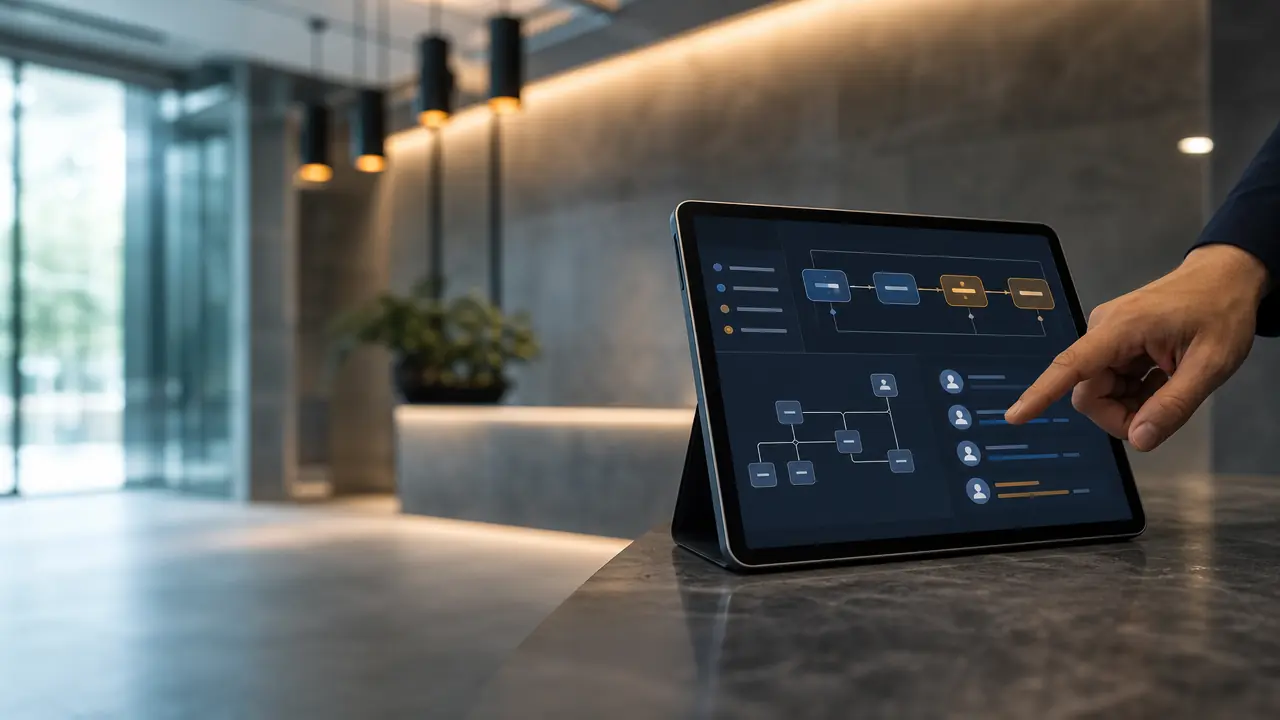
Authorised users can define approval steps, conditions, task assignments, and notifications through visual tools. Threshold-based routing, location-driven assignment, and SLA rules can be adjusted without a software development cycle for every small change. This means the platform responds to frequently changing operational requirements far more quickly than a traditional development-led approach would allow.
Mobile Task and Approval Centre
Every user sees all tasks assigned to them in a single mobile inbox. Approvals, rejections, requests for further information, document uploads, and comments are completed within the application. Push notifications are triggered for approaching SLA deadlines and overdue steps. Processes remain as traceable, auditable records rather than being lost in e-mail threads.
Integration with Enterprise Systems and Data Orchestration
ICIFlowIQ is positioned as an orchestration layer that connects your existing enterprise architecture rather than creating a new data silo. ERP, CRM, HR, document management, BI, data warehouse, and bespoke applications are brought into the platform via API or messaging layer. A CRM record can trigger a process; an approved purchase request can automatically create an order in the ERP; a completed service form can update the corresponding CRM record. HR data governs the user authorisation matrix while process performance is exported to the BI environment.
04 How it works
Process Analytics and Continuous Improvement
The platform produces data from every workflow: start and end times, waiting points, rework rates, and workload distribution by user. AI can flag unusual delays and recurring bottlenecks; a process-mining approach makes the gap between the intended flow and the actual flow visible. This analytics capability moves digitalisation beyond replacing a paper form with a screen — it provides measurable evidence of which steps should be simplified or automated.

Security, Governance, and Enterprise Compliance
Role-based access control, single sign-on (SSO), full audit trails, data encryption, and an authorisation matrix are core architectural components of ICIFlowIQ. Data retention periods, access scope, and approval authorities can be defined separately for each process. The data sources used in AI features, prompt policies, and output logs can be configured independently to meet your organisation's security requirements. Organisations operating under UK GDPR or equivalent frameworks will recognise these controls as the governance baseline they expect.
Working with icitech to Scope Your Project
An ICIFlowIQ engagement begins with discovery and process analysis. icitech's analysis, UX/UI, software engineering, integration, data, and AI teams examine your technology architecture and data sources together, then design the mobile experience and integration architecture appropriate to your requirements. Proof of concept, pilot, and phased scale-up follow as the natural progression of the project. Modules, business rules, screens, reports, AI and LLM capabilities, and integrations are scoped only to the extent you need; nothing is added that does not serve a defined purpose.
05 Same group
Other products
- Enterprise Mobile SolutionsICISalesIQ: A Mobile Field Sales Platform Built Around Your Organisation
- Enterprise Mobile SolutionsICIEngageIQ: A Mobile Platform That Brings Content Intelligence to Every Field Sales Meeting
- Enterprise Mobile SolutionsICIFieldIQ: Make Field Operations Visible, Planned, and Measurable
- Enterprise Mobile SolutionsICIVisualIQ: Transforming Visual Field Audits into a Closed-Loop Operation with AI
- Enterprise Mobile SolutionsMobile Expense Management Designed Around Your Organisation's Finance Architecture
- Enterprise Mobile SolutionsICISampleIQ: A Mobile Platform for the Entire Sample Lifecycle, Tailored to Your Organisation
06 FAQ
Frequently Asked Questions
01Is ICIFlowIQ an off-the-shelf software package?
No. For each organisation, processes, data sources, and technology infrastructure are modelled from the ground up, so no two ICIFlowIQ implementations are the same.
02Can frontline staff use the system without technical training?
The mobile interface supports receiving tasks, completing forms, and submitting approvals without any technical background. The user experience is designed to suit both office-based and operational staff.
03Can ICIFlowIQ integrate with our existing ERP or CRM?
ICIFlowIQ can be integrated for bi-directional data exchange with enterprise systems. The integration architecture is determined during the scoping phase based on your current technology estate.
04How flexibly can approval processes be configured?
Conditional routing, parallel approval tiers, and time-out rules can all be designed to match your organisation's hierarchy. When business rules change, flows can be updated without rewriting code.
05What document types does AI-assisted processing cover?
Structured and semi-structured documents such as invoices, delivery notes, contracts, and quality forms can be parsed and mapped to the relevant fields automatically. Supported document types are confirmed during the scoping phase.
06How do we monitor process performance?
The built-in analytics module visualises task completion times, bottleneck points, and team-level productivity in real time. This data provides the basis for periodic process reviews and improvement cycles.
07How is data security and access control managed?
Role-based authorisation, field-level data masking, and audit trail logging are provided as standard. Additional governance layers can be added in line with your organisation's compliance requirements.
08How long does implementation take?
Timescales depend on the number of processes in scope and the complexity of integrations required, so a separate project timeline is produced for each engagement. The scoping discussion is the first step towards a realistic delivery plan.
09Will performance degrade as user numbers grow?
The platform is built with an architecture capable of supporting enterprise-scale concurrent usage. Growth scenarios are addressed during the scoping phase so that capacity planning is done ahead of need.
10Can we start with a single department and expand later?
Yes. The modular structure means you can begin with a single process or department and follow a phased rollout plan. The outputs from each phase inform the scope of the next.
07 Contact