01 Case study · Tourism and hospitality
Replacing Fragmented Hotel Task Communication with a Mobile, AI-Assisted Workflow
icitech supports independent hotels and multi-site resort groups that run daily operations through mobile field teams. JO.ai — JobOrder Hotel Task Manager addresses the persistent problem of task communication that falls between channels: guest requests, housekeeping calls, maintenance issues, and internal assignments that begin as a phone call, a message, or a paper note and too often disappear before the next shift. With JO.ai, every task is raised, assigned, and closed within a single trackable mobile workflow.

01Challenge
Where Tasks Go Missing: The Real Friction Point in Hotel Operations
Hotel operations generate dozens of small, time-sensitive tasks simultaneously. A guest request, a maintenance fault, a housekeeping requirement, an F&B instruction, a security check — each one typically starts with a verbal instruction, a message, or a handwritten note, and a significant proportion fail to reach the next shift intact. The underlying friction is not simply that communication channels are fragmented. It is that staff face a real cost in routing the right information to the right team, and that no single view of operational status exists for the manager on duty.
02Approach
JO.ai: Bringing Task Creation Closer to Natural Working Behaviour
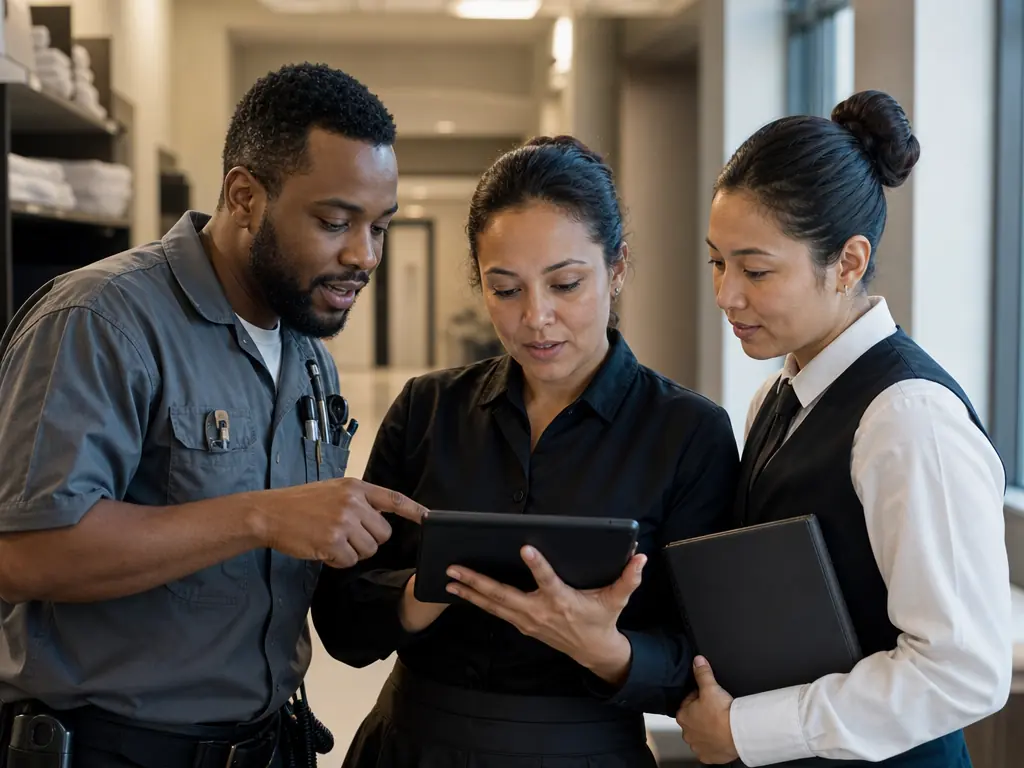
JO.ai — JobOrder Hotel Task Manager reduces that friction by moving task creation away from form-filling and towards photo, voice, and chat input. Field staff can describe a problem naturally, without needing to know the correct technical category; JO.ai converts that input into a structured task record and routes it to the relevant department or team member. The role of AI here is not an abstract conversational interface — it is a functional layer that lowers the threshold for raising a task record, so fewer issues are held informally and more reach the team responsible for resolving them.
ai — JobOrder Hotel Task Manager reduces that friction by moving task creation away from form-filling and towards photo, voice, and chat input.
03Solution
Shared Visibility Across Departments
Front office, maintenance, F&B, security, housekeeping, room service, concierge, and operations teams each carry distinct responsibilities, yet JO.ai brings all of them into a shared task-status model. Pending, in progress, completed, and delayed statuses apply uniformly across departments, providing a concrete mechanism to reduce the reliance on verbal handovers at shift changes. Because guest requests and internal operational tasks sit within the same trackable model, the duty manager can view the current state of operations from a single screen rather than consulting several teams in turn.
04Result
Operational Value: What the System Delivers in Scope
The measurable output of JO.ai is the conversion of fragmented in-property task communication into a trackable mobile task workflow. Photo, voice, and chat input converted to structured task records reduces the friction of logging; department and status visibility makes the flow of information between shifts systematic rather than incidental. The product also includes management-layer capabilities such as AI task routing, workload visibility, and operational dashboards. This page reflects only capabilities and use cases drawn from publicly available sources.
03 FAQ
Frequently Asked Questions
01Which types of hotel is JO.ai suited to?
JO.ai is designed for properties of any scale, from independent boutique hotels to multi-site resort groups. The system adapts to different team sizes and department structures without requiring a fixed configuration.
02Do staff need to abandon existing phone and messaging habits to use the system?
No — JO.ai creates a trackable workflow alongside existing communication channels rather than removing them. Staff continue to work from familiar devices while tasks are captured and routed formally.
03How do guest requests enter the system?
Front office or the relevant department logs the request through the mobile application within seconds of it being raised. This replaces verbal-only handling and reduces the likelihood of information being lost before it reaches the responsible team.
04What does the AI capability contribute to day-to-day operations?
The AI component analyses recurring task patterns and can surface assignment suggestions and priority recommendations. This reduces the volume of manual routing decisions the duty manager needs to make.
05How are cross-departmental tasks coordinated?
Each department manages its own task queue while also having visibility of workload across other teams through a shared dashboard. This makes it possible to identify bottlenecks or delays before they affect service.
06Does the system function in areas with poor or no connectivity?
The mobile application is designed to maintain core functionality when a connection is unavailable. Data synchronises automatically once connectivity is restored.
07Can managers report on task completion times?
The system records the opening and closing time of every task, giving managers measurable performance data at department and property level. These records can be used to support operational improvement decisions.
08Is technical training required before staff can use the application?
The interface is kept straightforward to suit the pace of hospitality operations. Most team members are able to work independently after a brief introductory session.
09Does icitech provide support during implementation?
Yes — icitech provides implementation support including property-specific configuration and initial training. Technical support access continues after go-live.
10Can the system manage multiple properties from a single view?
Multi-site groups can monitor task workflows across all properties from a central view, with group-level reporting available alongside each property's local settings.